
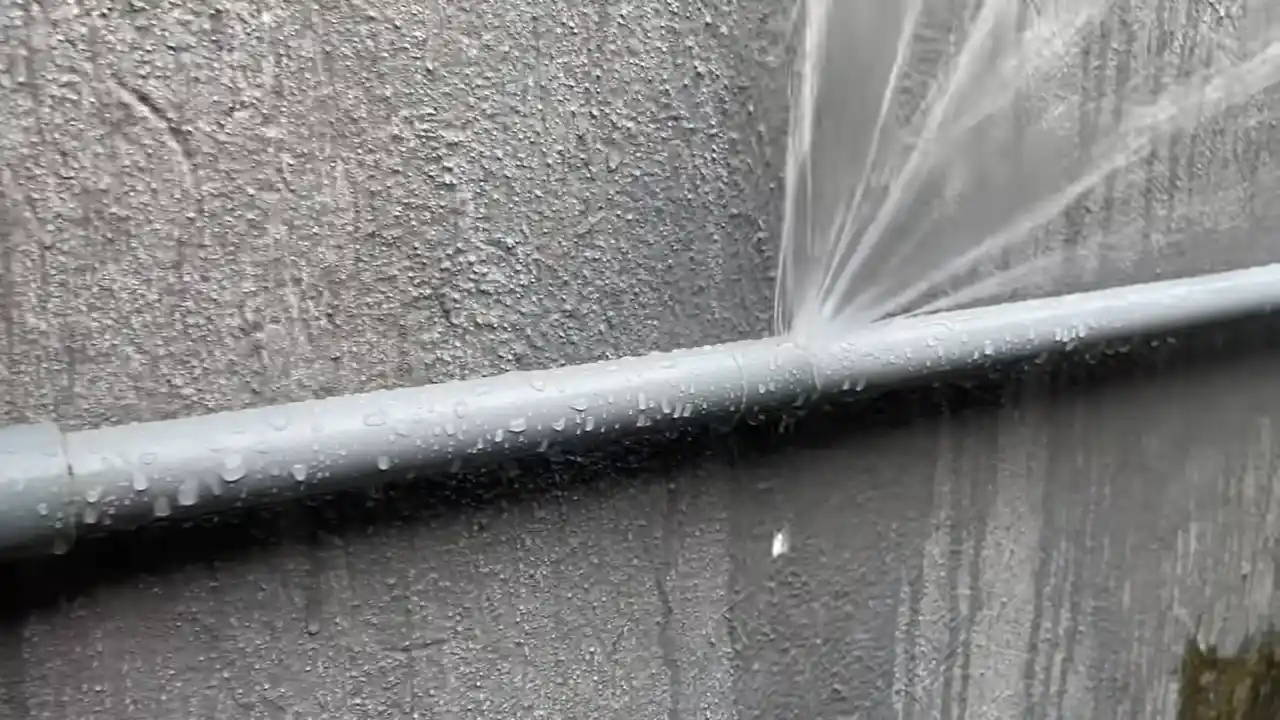
The Westwood, Mountain View, and Lakeshore neighborhoods in Loveland were built through the postwar and early suburban decades. The copper supply plumbing installed in those homes in the 1960s, 1970s, and 1980s is now forty to sixty years old. That age band is exactly where copper enters its most failure-prone phase.
A single pinhole is a repair. A pattern of pinholes, three failures in two seasons, multiple green-stain fittings, is a conversation about the whole system.
Why Copper Gets Pinholes
Copper pipe fails at pinholes through a combination of water chemistry and time. Loveland Water and Power draws from the Big Thompson River and stores in Green Ridge Glade Reservoir, a surface-water system that LWP treats to maintain moderately hard water at the distribution level. Moderately hard water carries dissolved minerals, primarily calcium and magnesium carbonates, that deposit as scale inside pipe walls. That scale layer can protect the copper in some conditions and act as a concentration cell for corrosion in others, depending on flow rates and pH.
The failure pattern that results is distinctive: tiny through-holes, typically smaller than a pencil tip, often at a point of turbulence such as an elbow, a tee, or a transition to a fitting. The water that escapes is sometimes only a slow drip, but that drip is at pressure and continuous, so it has months to wet a wall cavity, grow mold, and stain drywall before anyone finds it.
What a Pinhole Failure Looks Like
The early signs of a pinhole are easy to miss. A faint musty smell in a room that is otherwise dry. A small green or white stain on drywall that appears slowly over weeks. A ceiling spot that looks like an old stain but has not been there before. Low pressure at a single fixture that is otherwise not explained.
By the time a wet patch appears, the leak has been running for weeks or months. The copper at the failure point has been leaking at pressure the whole time, and the wall or floor cavity has been absorbing the result.
A professional pinhole assessment that uses moisture scanning and pressure isolation can find active pinholes in walls before they show on the surface. It can also evaluate exposed copper runs, the basement lines, utility closet runs, and under-sink supplies, to estimate how much of the system shows early corrosion signs versus healthy copper.
Pattern vs. Single Failure: The Key Distinction
A single pinhole in a forty-year-old copper system is a repair event. It means one bad spot in an otherwise reasonable pipe. A second pinhole in the same season, especially in a different branch of the system, means the corrosion front is broader than one bad fitting, and a repair-as-you-go approach will keep producing repair events indefinitely.
| Copper age | Typical condition | Recommended action |
|---|---|---|
| Under 25 years | Generally sound; early-generation PEX may also be present | Inspect exposed runs; monitor |
| 25–40 years | Some scale buildup; fittings may show early corrosion | Inspect fittings; repair singles as found |
| 40–55 years | Active pinhole risk; pattern failures possible | Full inspection; discuss plan vs. chase strategy |
| Over 55 years | High risk across system; probable galvanized branches in original sections | Repipe conversation warranted |
Where Pinholes Hide in a Loveland Home
The failures are not random. They cluster at points where the water chemistry acts most aggressively on the copper: at elbows and tees where turbulence concentrates mineral deposits, at horizontal runs where scale builds on the bottom of the pipe rather than distributing evenly, and at any transition from copper to a dissimilar metal fitting, where a small galvanic cell accelerates local corrosion. In a typical 1970s-era Loveland home, the horizontal basement runs and the under-sink branches are the early inspection priorities.
Inside wall pinhole failures are the most damaging because they are the slowest to find. A drip rate of two to three drops per minute is invisible in a home’s daily water use but over months will wet a stud cavity continuously. By the time a homeowner sees a stain, the cavity has been wet for at least six to eight weeks. Moisture scanning of the walls adjacent to known copper branches, before any stain appears, is the proactive version of pinhole detection. Book a scan at (303) 552-3896 if a copper home is in the 40-55 year range and has not been assessed.
The Loveland Water Chemistry Factor
Loveland Water and Power draws from the Big Thompson River and stores in Green Ridge Glade Reservoir, treating it to meet all federal standards. The distribution water is moderately hard, which means it carries dissolved calcium and magnesium carbonates that deposit as scale inside pipe walls. That scale is protective at first, lining the copper interior with a mineral layer that slows corrosion. After decades, the scale layer becomes irregular. Areas where the scale is thick insulate the copper; areas where it is thin or missing concentrate the corrosion. The result is the pinhole pattern: scattered single failures in a system that otherwise looks reasonable.
The moderately hard LWP water is not a water-quality problem; it is the normal chemistry of a surface-water system operating as designed. The pipe-failure risk it creates is about time and copper age, not about anything wrong with the supply. Understanding that distinction helps when the conversation turns to the repipe decision: the question is not whether the water will be fixed, but whether the pipe inventory is worth repairing one more time.
The Repipe Question
At some point, a copper system stops making economic sense to repair individually. The math is simple: if the cost of the next repair plus the last two repairs approaches the cost of replacing the worst sections of the system, a staged repipe of the highest-risk branches stops being a big expense and starts being the cheaper path forward.
The honest repipe conversation in Loveland starts with a look at the exposed runs. A plumber who can inspect the under-sink supplies, the basement horizontal runs, and any utility-closet sections can give a practical estimate of how much of the system is showing the early green corrosion that precedes pinholes. That inspection costs far less than a fourth or fifth emergency repair.
What Loveland’s Water Does Over Time
LWP surface water is treated and monitored, and the system is compliant with EPA lead and copper rule requirements. The corrosion risk in Loveland copper is not about water quality problems; it is about the natural chemistry of moderately hard water acting on metal pipe over decades. That chemistry is slow. On a new pipe it is harmless. On a fifty-year-old pipe at an elbow joint, it is the mechanism that creates pinholes.
Homeowners in the established Loveland neighborhoods, particularly the Westwood and Mountain View grids and the older sections of downtown, are in the age range where a proactive pipe inspection is worth the cost. The alternative is waiting for the leak to surface, which means waiting until the damage is already done.
The Westwood and Mountain View Timing
The densest concentration of 1960s-1980s copper in Loveland runs through the Westwood and Mountain View neighborhoods on the west side, and through the older sections of the central grid near downtown. These are the areas where Westwood homeowners and Mountain View residents are now most likely to encounter their first or second pinhole.
A first pinhole in a forty-five-year-old Loveland copper system is not a surprise. It is the system announcing that the corrosion front has arrived. The decision is whether to chase it one repair at a time or address the system age directly with a plan. That decision should be made with a look at the exposed runs, not from a position of surprise after the second emergency call. Call (303) 552-3896 to book the exposed-run inspection that turns that decision from a guess into a plan.
Call (303) 552-3896 to book a pinhole inspection of exposed copper runs and a plan discussion for any system that has already produced one failure.