
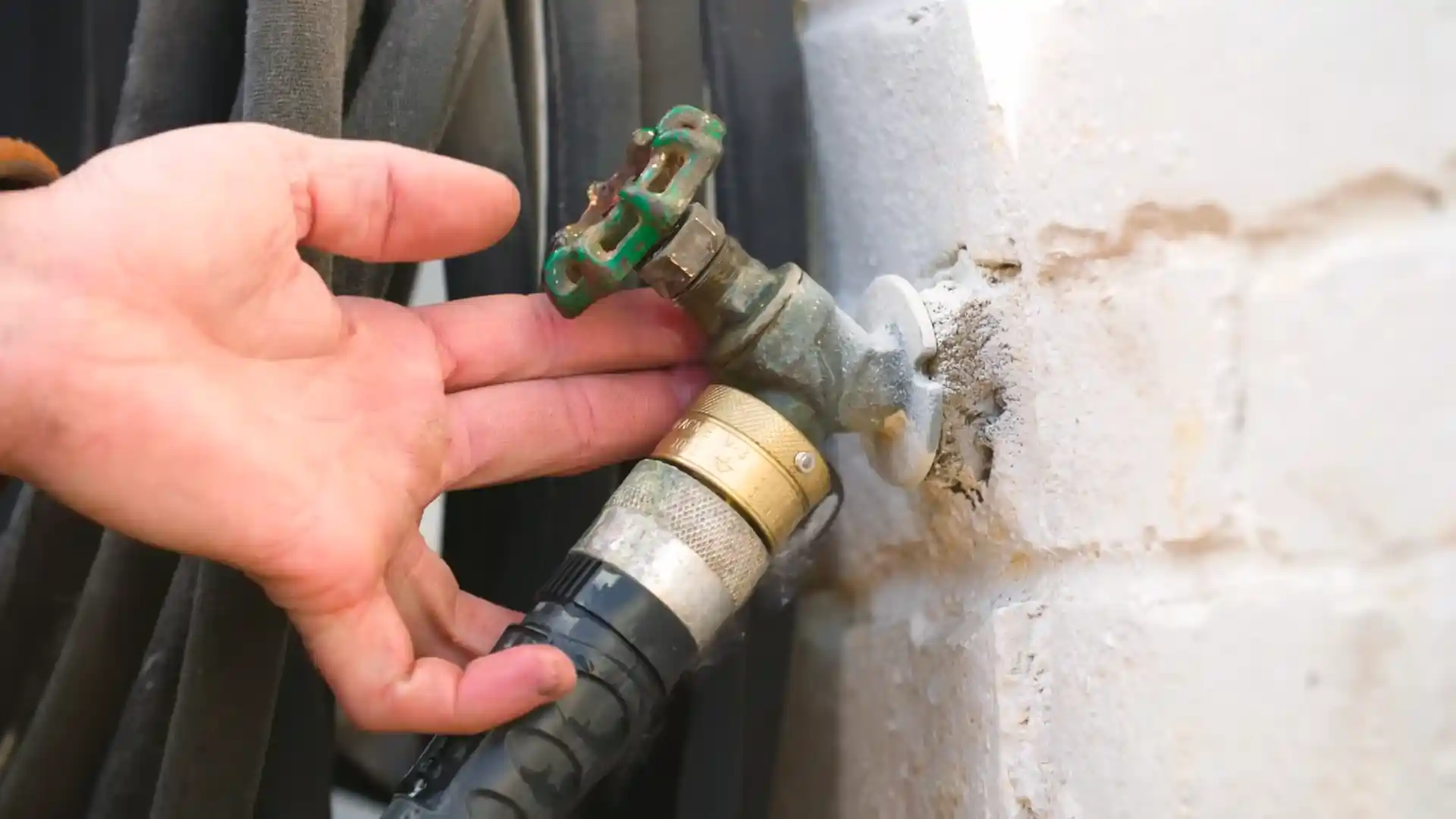
Every spring, Loveland plumbers run the same call: a homeowner turned on the outdoor faucet for the first time, heard nothing, went inside, and found water pouring through the wall. The pipe cracked months earlier during a January freeze. The damage has been sitting in the wall since. The cause, almost every time, is a garden hose left connected to the bib in October.
This is Loveland’s most predictable pipe failure. It is also one of the easiest to prevent, once you understand why the frost-free design only works when nothing is blocking it.
How a Frost-Free Hose Bib Is Designed to Work
A standard hose bib seats its shutoff washer right behind the exterior handle, in the part of the faucet that sticks through the wall. When that faucet freezes, so does the water sitting at the shutoff point.
A frost-free design moves the shutoff point eighteen to twenty-four inches back inside the wall, into conditioned or semi-conditioned space. When you close the handle, water stops flowing at a point that stays above freezing, and the short exposed section drains itself dry before freezing temperatures can act on it.
That drain works by gravity. It requires the faucet body to be tilted slightly downward toward the outside, and it requires the outlet to be open so air can enter as water drains out.
A garden hose attached to the outlet creates back pressure. The faucet cannot drain. Water sits in the exposed section. The exposed section freezes. The pipe body cracks.
Why Loveland’s Zone Makes This a Real Risk
Loveland sits in USDA Plant Hardiness Zone 5b, with a frost line around 30 inches deep. Temperatures regularly reach single digits in January and February, and the 2020 Cameron Peak Fire burn area to the west alters local wind patterns enough that exposed walls on the west and northwest sides of properties face additional wind-chill load on cold nights.
A frost-free bib rated for this climate does exactly what it is designed to do, right up until the hose defeats it. That is why the fall disconnect matters more in Loveland than in a milder climate.
The Spring Surprise: What the Crack Actually Looks Like
When a frost-free bib pipe cracks inside the wall during a January freeze, it does not leak immediately. The water in the pipe is ice. When spring arrives and you open the bib, pressure pushes water into the crack and the wall cavity simultaneously. Water sprays from the bib and from inside the wall at the same time, or the water entering the wall moves through insulation and framing and surfaces as a wet ceiling or floor somewhere below.
The common pattern in Loveland homes is water appearing at a lower-level ceiling about fifteen minutes after someone first uses an outdoor faucet in March. By that point, the wall cavity has already received a flush of water. Drywall, insulation, and any wood in contact with the wall section have already taken a hit.
A professional assessment before anyone opens the wall establishes where the crack is and how far the water traveled. It also establishes the cause, which matters for any insurance conversation.
Frost-Free vs. Standard: The Key Differences
| Feature | Standard bib | Frost-free bib | Note |
|---|---|---|---|
| Shutoff location | At the wall face | 8–24 in. inside wall | Frost-free moves risk indoors |
| Self-draining | No | Yes, when outlet is open | Hose attached defeats this |
| Freeze risk with hose on | High | Just as high | Same failure mode |
| Requires winterizing? | Yes, mandatory | Yes, hose off and outlet clear | Both need fall attention |
| Repair if cracked | Replace bib + check pipe | Replace stem + check pipe | Wall access sometimes needed |
The Fall Disconnect: What It Actually Takes
Winterizing an outdoor faucet properly is a two-minute task. Remove the hose. Open the bib handle briefly to let any residual drain out. Close it. If the bib has an interior shutoff valve, turn it off and open the exterior handle to drain the pipe section between the two valves. That is it.
If the exterior wall is on the north or west side of a Loveland home, or if the wall has no insulation directly behind the bib, consider adding foam insulation to the pipe section behind the wall if access allows. The main protection is the disconnected hose and the drained pipe. No hose, no trapped water, no freeze.
The spring first-use test also matters. Before using outdoor water for the first time each year, run the bib briefly while watching the interior wall below the bib location. If anything is damp or dripping inside after a few seconds, shut the bib off and call (303) 552-3896 before using it again. Catching the problem at the turn-on is far cheaper than finding it at the ceiling stain three hours later.
When a Bib Drips Year-Round
A slow drip from a hose bib that is not freeze-related usually means a worn washer or O-ring at the seat, or a damaged valve stem. These are inexpensive repairs when caught before a freeze. A bib that drips going into winter is a bib with compromised internal components that give water more places to sit and expand. Minor drip plus connected hose plus January is how a small seasonal repair becomes a wall-opening project.
If a bib drips at the handle, at the packing nut, or at the body, have it looked at before October. The repair cost is a fraction of the drywall repair and mold remediation that a wall-flooding event requires.
The Wall the Spring Flooding Comes From
The most common path for freeze-split water is behind the exterior wall siding, down the cavity between studs, and into the bottom plate. From there it can run along the subfloor to the nearest penetration and appear as a wet ceiling spot in a room well away from the bib. Homeowners often do not connect the ceiling stain to the outdoor faucet because the two appear so far apart.
A thermal scan of the interior wall behind a bib, run while water is active, maps the moisture boundary precisely. It tells a contractor where to open the wall and where to stop. Without it, a contractor guessing at damage extent typically opens more than necessary. With it, the opening is sized and placed with evidence.
What to Do If You Find the Problem in Spring
If the first outdoor use of the year produces a wet sound inside the wall, or if water appears on a ceiling below within the first few minutes, shut the bib off immediately. Do not keep running water through it to investigate. The hole in the pipe is delivering pressure-fed water into the wall every second the valve is open.
Shut off the interior shutoff valve for that bib if there is one, or shut off the main supply to stop the flow. Then call (303) 552-3896. The assessment starts with the bib, works back through the wall to the pipe, and uses moisture scanning to map how far the water traveled before you caught it. The scope of that scan determines the remediation cost, not the other way around.
Homes on Exposed Sites
Properties along the High Plains edge of Loveland, in exposed High Plains and Centerra-adjacent subdivisions, and on lots without wind-breaking landscaping face the highest outdoor-plumbing freeze risk in the region. Open exposure lets wind strip heat off exterior walls at night faster than it does on a sheltered lot, and what is a moderate freeze on a sheltered downtown street can be a pipe-splitting event on an exposed east-side wall.
The pipe leak assessment after any suspected freeze starts with the bib and works inward, because a cracked bib is common but a cracked section of buried supply near the house is possible too, especially on lots with shallow or uninsulated exterior walls.
(303) 552-3896 handles freeze assessments year-round and can book a preventive bib check before the first hard freeze of the season.