
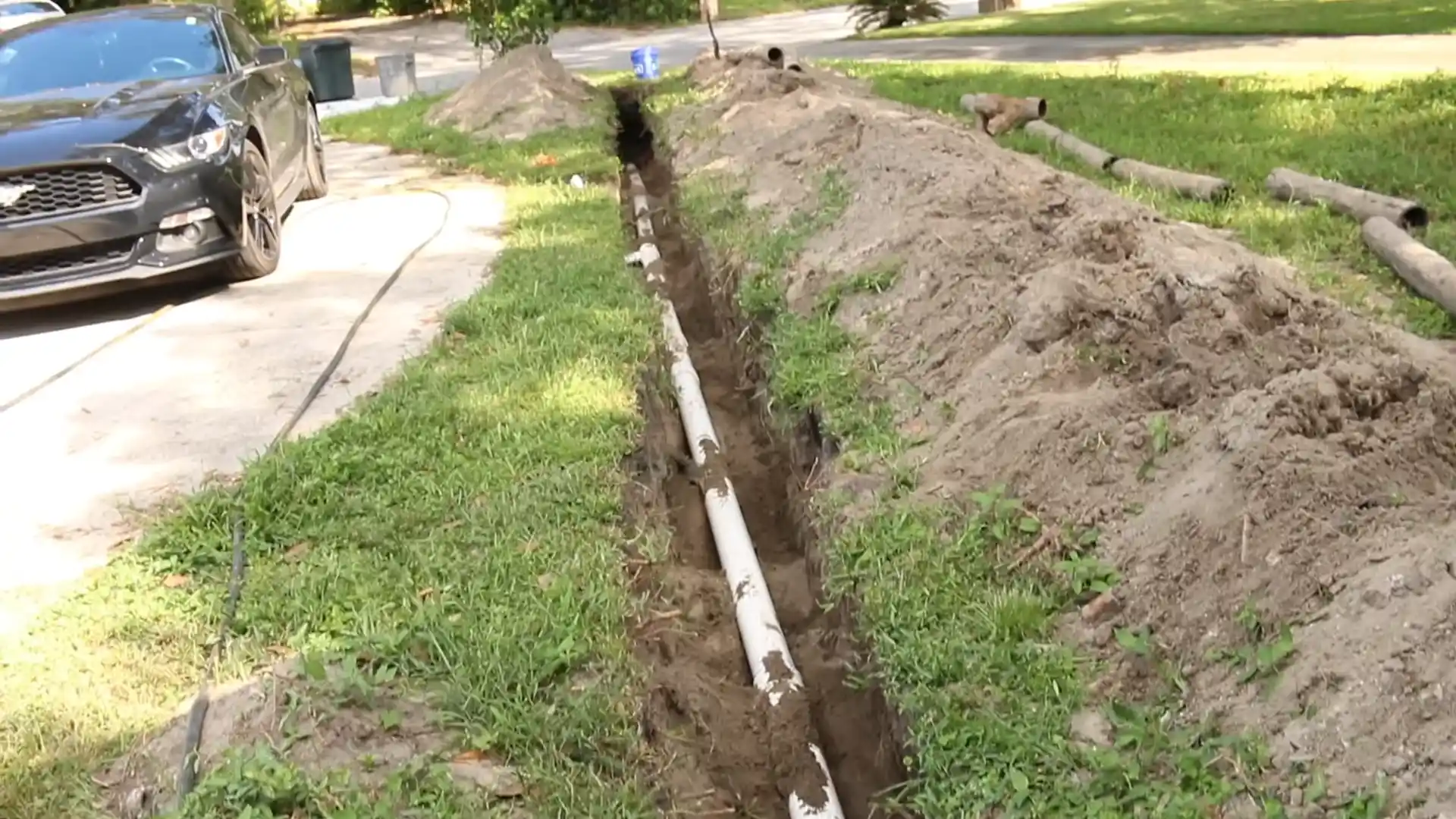
Downtown Loveland and its older grid neighborhoods have two things in common: mature trees that arch over the streets and sidewalks, and cast-iron sewer laterals that have been underground since the same era those trees were planted. The Colorado Central Railroad reached Loveland in 1877, and the residential grid that grew around it carried the plumbing standards of its time. Much of that original lateral inventory is still in the ground.
Roots and aging cast iron are a slow-motion story. The trees that make a Loveland block beautiful send feeder roots toward the one reliable moisture source underground: a sewer lateral with a hairline crack or a loose joint. What starts as a root tip following a moisture scent becomes a mass that snags every flush within a few seasons.
What the Camera Actually Shows
A sewer camera run down the lateral converts a slow-drain complaint into a picture with GPS coordinates. The camera reads several conditions that are not visible any other way:
Root intrusion stage. Camera footage grades root intrusion from hairline wisps at a joint gap to a full obstructing mass that blocks more than half the pipe interior. Early-stage intrusion looks like white threads at a joint; advanced intrusion looks like a dense fibrous plug. The stage determines the repair path.
Pipe wall condition. Cast iron that has been underground for forty or fifty years often shows internal corrosion, scale buildup, and hairline fractures in addition to root entry points. The camera shows all of these. A lateral that has four root entry points and significant internal corrosion tells a different story than one with a single intrusion at a sound joint.
Pitch and pooling. A properly pitched lateral runs at a consistent slope toward the main. Camera footage that shows pooled water or sags in the line means the grade has shifted, typically from ground movement or from the soil consolidation that happens around aging buried pipe. A sagged section retains solids and creates a recurring-clog location independent of any root issue.
Joint offsets. Ground movement in Loveland's expansive clay can push cast-iron joints slightly out of alignment, creating a lip that catches solid material even before roots find it. An offset joint that is also a root entry point is a higher-priority repair than a clean root intrusion in an otherwise sound pipe.
Camera Findings and What They Mean for Repair
| Camera finding | Typical repair | Urgency |
|---|---|---|
| Early root intrusion at single joint, pipe wall sound | Hydro-jet cleaning, monitor annually | Medium |
| Root mass blocking 30-50% of bore, pipe wall sound | Hydro-jet, inspect again in 6-12 mo | High |
| Root mass plus corroded or fractured pipe wall | Trenchless liner or spot repair | High |
| Multiple root entries across 20+ feet of run | Full-run trenchless reline | High |
| Sagged or offset sections with intrusion | Excavation and replacement at sag point | Very high |
| Grease accumulation plus mild root | Hydro-jet, dietary change, monitor | Medium |
The Trenchless Liner Option
The repair that has changed the math on Loveland's older laterals is the cured-in-place pipe liner, also called a trenchless reline. A flexible liner soaked in epoxy resin is pulled into the existing pipe and inflated against the walls. The resin cures, and the result is a new smooth pipe inside the old one, sealed at every joint and gap that admitted roots. The old cast iron stays in the ground; the new liner carries the flow.
The liner method is especially useful on tree-lined Loveland blocks where an open-trench repair would require removing sidewalk, parkway trees, or hardscape. The liner installs through two access points, and the parkway stays intact. On the Downtown grid and the older westside streets, this is the repair that preserves the landscape that took fifty years to grow while fixing the infrastructure that has been failing for a decade.
Trenchless lining is not the right answer for every lateral. A pipe with severe structural collapse or offset joints cannot accept a liner without a spot excavation at the problem section first. The camera run tells you which scenario you are in.
How Long Does a Cleaned Lateral Last Before Roots Return?
Hydro-jet cleaning removes the root mass but does not close the entry point. The roots will return, typically within twelve to eighteen months on a lateral with active root pressure from a large adjacent tree. Annual cleaning is a maintenance budget; a liner or spot repair at the entry joint is a capital budget. The decision point is whether the pipe wall is sound enough to justify indefinite annual cleaning, or whether the camera footage shows deterioration that makes repeated cleaning a declining return on cost.
Call (303) 552-3896 to schedule a camera run on any Westwood or downtown Loveland lateral that has slow drains, gurgling sounds, or a backup history. The camera run takes about an hour and produces footage that frames every subsequent decision.
The Downtown and Grid-Neighborhood Timing
The densest concentration of 1950s-1970s cast-iron laterals in Loveland runs through the Westwood, Mountain View, and downtown grid neighborhoods. These are also the blocks where the tree canopy is most established, meaning the root pressure on aging laterals is highest. A household in these neighborhoods that has not had a camera run on its lateral in the past five years is probably overdue.
The staged repipe plan also creates an opportunity to upgrade from galvanized to sound supply pipe in the worst sections without waiting for a full-house project. A main-run replacement, the horizontal basement line that feeds all upper branches, eliminates the primary pressure-drop problem and stops the most common emergency call pattern, often for a fraction of the full repipe cost. The remaining branches can be evaluated and scheduled as the budget allows.
Cast iron that was installed in 1965 is now sixty years old. It was designed for a service life of fifty to seventy-five years, which means the population of laterals in these neighborhoods is now entering the zone where failures are not surprises; they are scheduled events. Knowing the pipe's condition before the backup is cheaper than learning it during one.
Call (303) 552-3896 to book a camera run for any property on a tree-lined block with original plumbing. The camera footage is the information that makes every subsequent drain-maintenance decision a choice rather than a reaction.
Signs That a Camera Run Should Move Up the Priority List
Most slow-drain complaints start mild and worsen slowly. Root intrusion that takes three years to develop enough to back up a toilet often develops faster the second time, because the jet cleaning that cleared the roots did not close the joint gap the roots entered through. A household that has cleared a slow drain twice in five years should treat the third occurrence as a camera-run trigger, not a jet-cleaning event.
Other triggers: any gurgling from a floor drain or toilet when another fixture is used, any sewage odor in a basement or crawl space, and any instance of sewage backing up into a lower fixture during a washing-machine cycle. All of these indicate a partially obstructed lateral that has not yet fully backed up but will.
The camera run that finds the problem three months before the full backup is a planned expense. The camera run that happens during the backup is an emergency call rate. Call (303) 552-3896 for the planned version.