
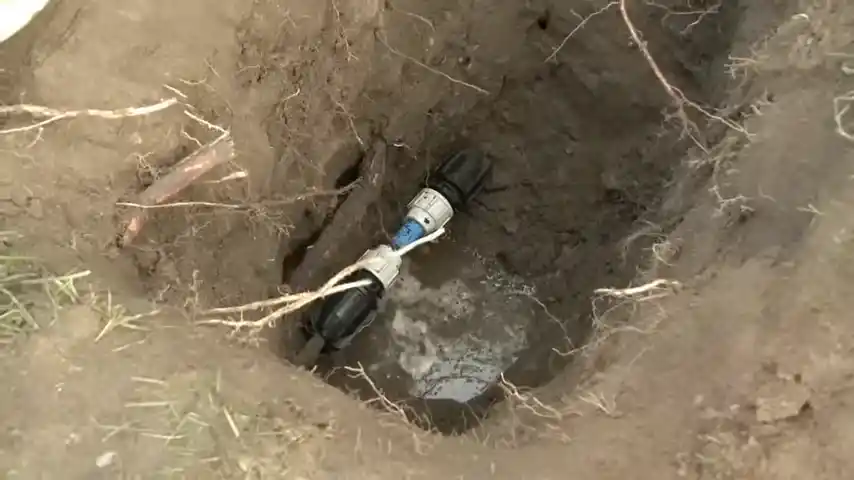
A Loveland homeowner notices a damp patch in the back corner of the yard, well away from any sprinkler head. The patch stays wet through a dry week. The water bill climbed two months ago, then again last month. The toilet and fixtures all look fine.
The soggy patch is probably not where the leak is. That is the part that catches northern Colorado homeowners off guard: buried pipe failures on expansive Front Range clay rarely surface where the pipe runs. They surface where the soil eventually lets them up, which can be one lot line, two lot lines, or an entire slope away from the actual break.
Why Buried Leaks Wander in Loveland’s Soil
The bentonite clay that underlies most of Loveland’s residential grid holds and moves water differently than stable sandy or loam soil. When a buried pipe fails, the escaping water enters the clay and follows the path of least resistance, which is usually downslope and along any gravel or sand layer that runs between the clay masses. On a level lot, water can travel twenty to forty feet horizontally before finding a path to the surface. On the west-side grades near the foothills, or along the river-terrace lots near the Big Thompson, it can travel much farther.
This migration means the wet spot is evidence that a leak exists somewhere, but not evidence of where. Treating the wet spot as the location is how homeowners end up with an excavation that finds nothing, because the pipe runs in a completely different direction.
The Meter Test First
Before any locating work begins, the water meter settles the basic question: is water leaving the pressurized system at all? Shut off every fixture in the house and check the meter dial. If it moves with everything off, a leak exists. If it does not move, the wet area may be groundwater, irrigation drift, or a drainage issue rather than a pipe failure.
Once the meter confirms a leak, the next step is to isolate whether it is between the meter and the house (service line, the homeowner’s responsibility) or inside the home. Closing the main shutoff valve and rechecking the meter tells you which side of the house the failure is on.
A service-line failure in Loveland runs from the meter box at the curb to the point where the pipe enters the foundation. That run can be fifty to a hundred feet or more on larger lots, and every foot of it is the homeowner’s responsibility to repair.
How to Read the Wet Spot’s Shape
Before calling anyone, walk the property and describe the wet zone in terms of shape and location. A circular wet area tends to indicate a leak source directly below or very close by. A linear wet pattern along a fence line or landscape bed usually follows a buried pipe run. A large wet zone near the street or curb box is often a service-line failure at high pressure near the meter. A wet area that appears after irrigation cycles and dries between them is almost certainly an irrigation failure rather than a supply-line problem.
That shape description is the first information a locating technician needs. It tells them which system to pressure-test first and where to start the line trace. A detailed description on the phone often cuts the on-site time significantly.
What Yard Symptoms Actually Indicate
| Symptom | Probable cause | Urgency |
|---|---|---|
| Wet patch that persists through dry weather | Underground pipe failure or high water table | High; run meter test today |
| Unusually green stripe or faster-growing grass | Slow ongoing supply leak feeding roots | Medium; check meter, monitor |
| Soft or spongy ground underfoot | Saturated soil from sustained leak | High; risk of surface collapse |
| Wet patch near street or meter box | Main service line failure near curb | Very high; notify LWP + call plumber |
| Wet patch with bad odor or discolored water | Sewer line or septic failure | Immediate; health hazard |
| Wet patch only during irrigation cycles | Irrigation line or head failure | Medium; check zones |
How Professional Locating Works on Clay Ground
Finding the source of a buried leak on Loveland’s clay soil requires two things the wet spot cannot provide: the pipe route and the failure point. Professional underground leak detection starts by tracing the buried pipe itself, painting its route on the surface so the search area is defined. On a clay soil site, acoustic listening is run at close sensor spacing because clay absorbs sound faster than sand or gravel. For service lines where clay has swallowed the acoustic signature, tracer gas or electronic correlation picks up what the listening alone cannot confirm.
Once the pipe route is on the surface, pressure isolation narrows the failure to a specific segment. That segment gets audio correlation from two sides, and the point where the correlation signal peaks is marked. On good clay ground with reasonable access, the marked spot is accurate to within a foot or two, meaning the dig is small. Reach (303) 552-3896 any hour to book a professional locate for a suspected service-line or buried-pipe failure.
On west-side grade lots, an escaping leak can surface a lot line below its source, which is why electronic correlation from above, not just from the wet spot, is standard practice on the hillside neighborhoods near Mariana Butte and along the Devil’s Backbone approach roads.
What Happens If You Wait
A buried supply-line leak that loses a gallon per minute is losing 1,440 gallons per day. At Loveland Water and Power rates, that is a meaningful monthly number. But the hidden cost is the soil saturation: a sustained leak under a foundation edge can soften the clay support layer enough to allow differential settlement, which shows up as cracked drywall, sticking doors, or sloped floors. The soil and foundation damage from months of a slow underground leak can dwarf the pipe repair cost.
The soggy-yard finding also does not go away on its own. Buried supply lines are under constant pressure. Without a repair, they keep running.
Homeowners in the Thompson Heights neighborhood and the river-terrace properties near the Big Thompson face additional underground-leak migration challenges because the cobble-and-fill soil along the terrace scatters buried water even more than standard clay does. A service-line failure on a terrace lot may surface two or three lots downhill before it rises. On these properties, the tracing step, painting the pipe route on the surface before any locate reading, is not optional. Call (303) 552-3896 for river-terrace locate work that accounts for the ground’s scattering behavior, and brings the right sensor spacing for cobble-and-fill soil where standard close-grid acoustic misses half the signal.
(303) 552-3896 runs meter tests and professional locates across Loveland and the surrounding communities, including the Big Thompson Valley and adjacent towns. Call before digging. The mark goes where the leak is, not where the wet spot is.