When a Loveland homeowner finds a damp patch on a wall or ceiling, the instinct is to open the drywall and look. The problem is that the patch is often where the water ended up, not where the pipe failed. Opening the wrong section costs money and does not find the leak.
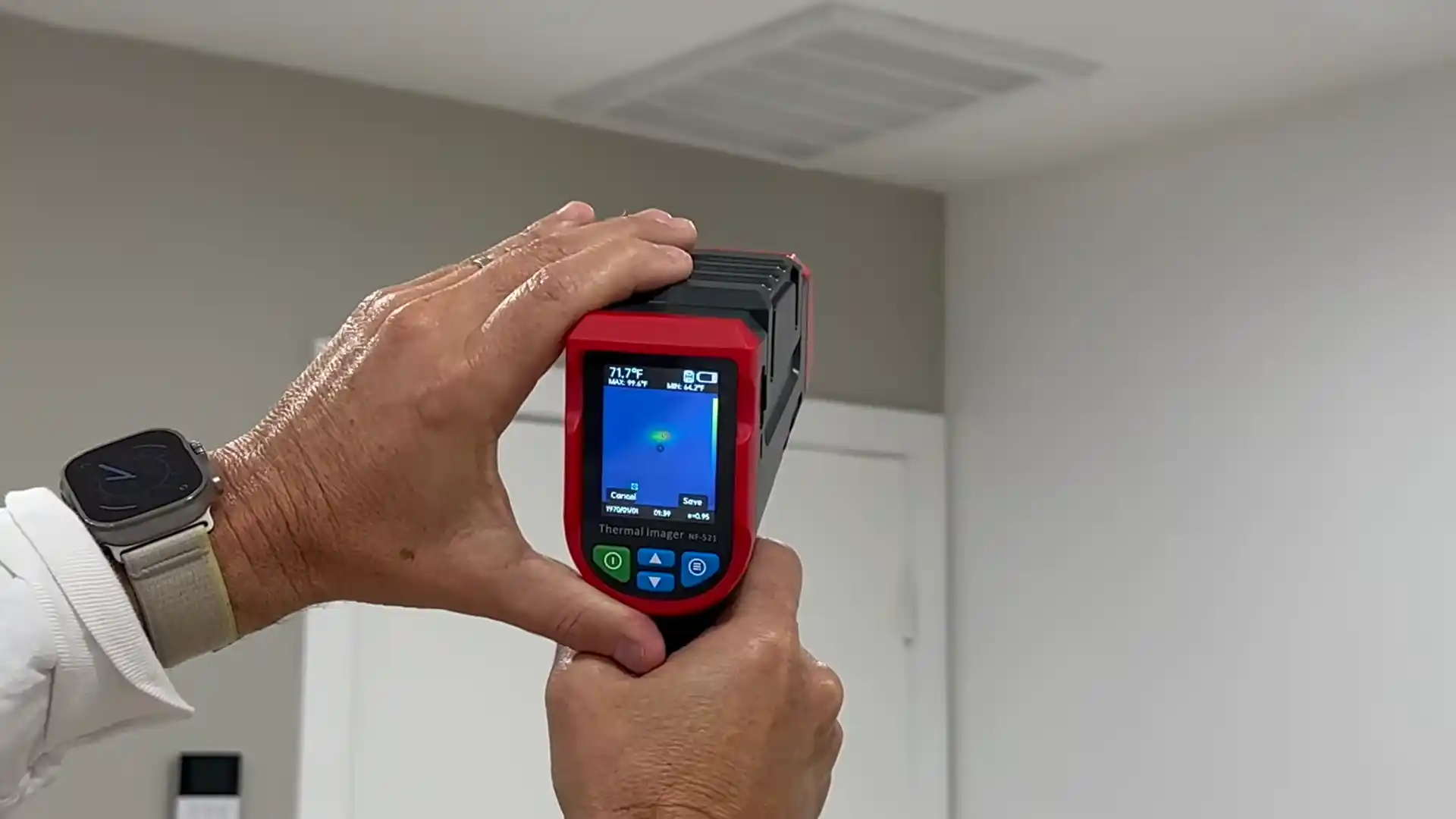
Thermal imaging changes that sequence. A camera run over the suspect surface before anything is opened gives a picture of where the moisture boundary actually is, whether the wet patch is the source or a tributary, and sometimes identifies a pipe location that has not yet surfaced at all.
Here is exactly how the tool works, what it reliably finds, and where it has genuine limits.
What the Camera Is Actually Measuring
A thermal imaging camera does not see moisture. It measures infrared radiation, which corresponds to surface temperature. It produces a false-color heat map of the surface it is aimed at.
Water has a high specific heat capacity, meaning it holds and releases temperature more slowly than drywall or wood. When water is present in a wall, two things happen that the camera can read: first, a wet area stays cooler longer during the day and warmer longer at night than a dry area (temperature lag); second, water evaporating from a wet surface cools that surface, creating a temperature anomaly relative to dry adjacent material.
The camera finds these anomalies. On a standard drywall wall, a leak from a supply pipe behind the wall shows as a linear cool stripe following the pipe’s path, or as an amorphous cool blotch where water has spread through insulation. A hot-water supply leak shows as a warmer-than-normal area before evaporative cooling takes over.
Conditions That Make the Camera More or Less Useful
Thermal imaging works best when there is a meaningful temperature difference between the wet area and the dry surroundings. On a day when the interior is 70 degrees and the wall material has been at that temperature for hours, a wet section may show a 3- to 5-degree difference, which is clearly readable. On a day when the room temperature has been fluctuating or when a supply run carries both hot and cold water in close proximity, the signals can cancel or compete.
Time of day matters. A scan performed in early morning, after the wall has equalized overnight, produces cleaner results than one performed in the afternoon after the sun has been heating exterior walls. Scanning after any active water event, while the water in the wall is still moving and evaporating, produces the most distinct signal.
What the Camera Misses
| Scenario | Thermal imaging | Backup method needed |
|---|---|---|
| Active supply leak behind drywall | Very good; linear anomaly along pipe path | Usually not needed for location |
| Leak that stopped weeks ago (dried drywall) | Limited; no temperature differential if dry | Moisture meter; invasive check |
| Leak behind thick stone or tile surface | Degraded; stone equalizes temperature fast | Moisture meter at grout joints; acoustic |
| Slab leak under concrete | Partial; reads surface temp if concrete is thin | Acoustic + pressure isolation is primary |
| Buried outdoor supply line | Limited in daylight; better at night or early AM | Electronic correlation + gas tracing |
| Small pinhole with very low flow rate | May miss if moisture spread is minimal | Moisture meter at fittings; pressure test |
How It Combines With Moisture Metering
The standard professional approach pairs thermal imaging with a contact moisture meter. The camera identifies where anomalies are; the meter confirms whether the anomalies correspond to actual moisture in the material, rather than to a thermal effect from an exterior temperature variation or a nearby heat source.
This two-tool approach is what distinguishes a professional thermal imaging assessment from a consumer camera used without backup instrumentation. The camera tells you where to put the meter. The meter tells you whether the camera is right. Together they produce a finding that justifies either opening the wall or concluding that the anomaly is not moisture-related.
The Non-Invasive Promise
The real value of thermal imaging in a Loveland home inspection is not just accuracy. It is the sequence it enables: camera first, invasive access only where the evidence stacks. In a home with finished walls, tile surrounds, or expensive flooring, that sequence means the repair opening is one hole in the right place rather than a three-foot exploratory trench cut into a finished bathroom wall.
For homeowners in planned communities with HOA covenants that require landscaping-impact approvals, or in historic downtown Loveland where plaster-and-lath walls reward careful access, the non-invasive approach has direct financial value beyond just finding the leak. The hole that is cut on the basis of a camera finding is a known, sized opening. The hole cut without it is a guess.
Reading a Thermal Anomaly Correctly
Not every temperature difference on a thermal scan is a leak. Exterior walls show thermal bridging at studs, which appears as a regular vertical striping pattern. An exterior wall section that was recently in direct sunlight retains heat unevenly. A recently run shower or dishwasher leaves a warm-water signature that fades over thirty to sixty minutes. A trained thermographer distinguishes these patterns from the signatures water makes: an amorphous blotch that does not follow framing lines, a linear cool stripe that follows a pipe route, or a spreading wet-cool zone that grows as active water continues to evaporate.
This interpretation skill is the difference between a thermal scan that produces a useful finding and one that produces a list of possibilities that need further investigation. When commissioning a thermal inspection, confirm that the technician reads the camera output at the time of the scan and interprets it in context, rather than delivering raw images for a homeowner to interpret later. Book a professional thermal assessment at (303) 552-3896 for any suspected hidden leak before any wall opening is attempted.
Thermal Imaging in Loveland’s Older Plaster Homes
Downtown Loveland’s pre-1950 homes carry original plaster-and-lath wall construction in many sections. Plaster has higher thermal mass than drywall, which means it equalizes temperature more slowly and can mask a small leak that would show clearly through a quarter-inch drywall sheet. Thermal imaging through plaster still works but requires more favorable conditions: a larger temperature differential, more time since the last active water event, and sometimes a morning-hour scan after overnight equalization.
For suspected leaks in historic Loveland interiors where plaster preservation matters, the non-invasive approach pairs thermal imaging with a moisture meter probe through existing small openings rather than cut new access. This keeps plaster intact until the locate report supports a specific, sized opening.
When to Skip Thermal and Start Elsewhere
A slab leak does not usually start with a thermal scan of the floor surface. It starts with acoustic listening through the slab, because concrete does not transmit the thermal signal the way drywall does. A buried outdoor line failure does not usually start with a camera either; it starts with meter isolation to confirm the leak is in the service line, then line tracing, then correlation.
Thermal imaging is the right first tool when the suspected leak is behind an interior wall or ceiling in a finished space. It is one supporting tool, not the primary method, for slab and underground work.
Call (303) 552-3896 to book a combined thermal and moisture assessment, which covers more leak scenarios than either tool alone. For a Mariana Butte or west-side hillside property, an underground leak assessment does not start with a thermal camera. It starts with a meter isolation test, then an acoustic sweep of the buried supply line, and the thermal camera may be used only for the interior wall sections where the water eventually showed up inside. Matching the tool to the surface and the failure type is the decision a professional makes before any sensor is placed.
Call (303) 552-3896 to discuss which detection toolkit fits the problem before committing to any opening. The camera is often the best first move. It is not always the only one.