
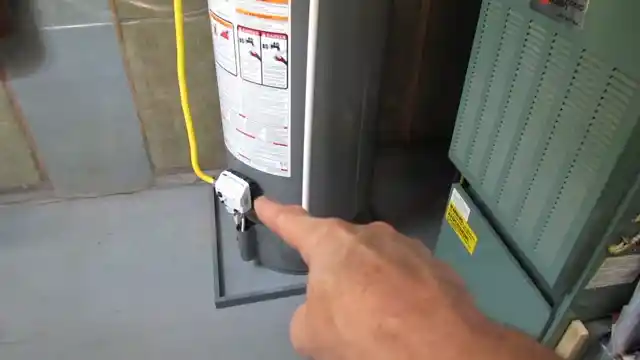
A puddle on the floor under the water heater is one of those findings that triggers an immediate call to a plumber. Before that call happens, take sixty seconds to look at exactly where the water is coming from. The location of the water is the single most important piece of information for anyone who has to decide whether a repair is needed or a tank replacement is imminent.
The Four Possible Sources
Water under a water heater comes from one of four places. Two of them are repairable without replacing the tank. Two of them usually mean the tank is at or near the end of its useful life.
Supply connections at the top. The cold-water inlet and hot-water outlet connections at the top of the tank both carry threaded fittings that can develop slow leaks from corrosion, scale buildup, or a fitting that has worked loose over time. Water from the top connections runs down the outside of the tank and pools at the base. These are repair-in-place situations: shutting the supply, draining the relevant section, and replacing or tightening the fitting. Call (303) 552-3896 if tightening the fitting does not stop the seep within a day.
The pressure relief valve (PRV) drain. The temperature-pressure relief valve on the side of the tank has a drain tube that should run to a floor drain or outside. If this valve is discharging, water will appear at the end of the drain tube, not at the tank base. A PRV that is discharging intermittently is either responding to genuinely high pressure (which warrants investigation) or is worn and needs replacement. A PRV that is stuck open is a repair item; a PRV that is discharging because the system pressure is too high is a signal that the pressure at the water heater may exceed safe operating conditions.
The drain valve at the base. The drain valve at the bottom of the tank develops slow seeps from scale buildup and mineral deposits in Loveland's moderately hard LWP water. A weeping drain valve is often visible as mineral scale or green corrosion around the valve body. This is a replacement-valve repair if caught early; a failed drain valve that cannot be stopped without a full drain-down is more involved but still not a tank-replacement event.
The tank bottom itself. Internal tank corrosion that reaches the outer shell produces a weep that appears at the very base of the tank, typically as a slow seep around the entire circumference of the bottom plate. This is the finding that means the tank is failing from the inside. Loveland's moderately hard water accelerates internal scale and corrosion when the anode rod depletes and has not been replaced. A tank weeping at the base typically has six to twelve months before it fails completely.
Reading the Water Location
| Where the water appears | Most likely source | Urgency |
|---|---|---|
| At or near supply fittings at top | Connection leak | Medium; repairable |
| At end of PRV drain tube | PRV discharge | High; check pressure |
| Around drain valve at bottom side | Drain valve seep | Medium; valve replacement |
| At the very base, around circumference | Internal tank corrosion | High; plan replacement |
| On floor far from tank | Condensation or supply line | Medium; investigate source |
What Loveland's Water Chemistry Does to a Tank Over Time
Loveland Water and Power distributes moderately hard water drawn from the Big Thompson River system. Hard water carries dissolved calcium and magnesium carbonates that precipitate inside a water heater tank as sediment, collecting at the bottom of the tank and building up over years. That sediment layer does three things: it insulates the heat element from the water above, forcing the element to work harder and cycling at higher temperatures; it creates a localized corrosion environment at the tank bottom where stagnant, mineral-rich water concentrates; and it eventually cracks and chips, circulating through the home's plumbing and depositing in aerators and fixture valves.
The standard defense is an annual tank flush to remove accumulated sediment, and replacement of the sacrificial anode rod every three to five years. The anode rod is the tank's primary corrosion protection. When it depletes and is not replaced, the tank's steel shell becomes the corrosion sacrifice instead of the rod. Loveland homeowners who have not flushed their tank in the past two years or who do not know whether the anode rod has been replaced are operating a tank that is aging faster than its rated service life suggests.
How Old Is Your Water Heater?
The manufacture date of a water heater is encoded in the serial number on the data plate. Most major brands encode it as the first four characters of the serial (two letters for month and year, or a year followed by a month digit). A Loveland home that has never replaced the water heater and was built in the 1990s may have a tank that is now thirty years old. Most residential tanks are rated for ten to fifteen years. A thirty-year-old tank that is still functioning is doing so on borrowed time, and a puddle under it is not a maintenance event; it is a planning trigger.
Call (303) 552-3896 for a professional assessment that identifies the source, evaluates the tank's remaining life, and gives you a repair-versus-replace recommendation based on actual findings rather than guesses.
The PRV Pressure Question
A PRV that discharges in a Loveland home occasionally is often responding to thermal expansion. When water heats in a closed system (a system with a check valve or pressure regulator), the expanding water has nowhere to go, and the pressure rises until the PRV releases it. This is normal in a closed system but puts cumulative stress on both the PRV and the tank's internal structure.
Loveland Water and Power operating pressure runs between 50 and 60 PSI in most of the distribution system, with a code-maximum of 80 PSI. A home with no pressure-reducing valve on a service line that runs closer to the high end of that range sees more thermal expansion stress than a home at 50 PSI. A gauge on the supply side of the water heater tells you the operating pressure. If it reads above 65 PSI, an expansion tank and possibly a PRV adjustment are the right preventive investments alongside any tank repair work.
When the Puddle Is Somewhere Else
A puddle that appears some distance from the water heater but in the same room may be condensation from a nearby cold-water line during humid summer months, or a supply-line failure upstream of the tank. A puddle on a finished floor in the room below a water heater may indicate that the supply connections or PRV have been draining into the wall for longer than expected. Call (303) 552-3896 if the water source is not obvious after a sixty-second inspection; the professional assessment takes that ambiguity out of the picture.
The Replacement Timeline
For any Loveland homeowner whose downtown Loveland or established-neighborhood water heater is in the 12-15+ year range, a tank that has started showing any of the above symptoms is better evaluated for replacement than for repair. The repair cost on a fifteen-year-old tank buys time on a system that is approaching the end of its service life. A new tank with a proper anode rod, set at a moderate temperature, and flushed annually can give fifteen to twenty years of service. That is usually the better spend on a Loveland home with hard-water history and an old tank.
When you call (303) 552-3896, tell us where the water is appearing and how long the puddle has been there. Both pieces of information shape the response.